
Recording business calls is completely normal, and in most of the country, you don't even need to tell the other person. Thousands of businesses record calls every day for training, quality assurance, and to keep track of what was discussed.
The rules are simple. In 38 states, you can record any call you're on without saying a word. In 12 states, you just need to say "this call may be recorded" at the start. That's the whole thing.
Across the 1,446,980+ inbound calls our AI receptionist has answered, systematic call review and training consistently improve how businesses handle customers. Recording calls is one of the easiest ways to get better at what you do.
This guide breaks down exactly what to do in each state, so you can record with confidence.
The Quick Version
If you don't want to read the whole guide, here's what you need to know:
- 38 states + DC are "one-party consent": you can record if you're on the call, no notification needed
- 12 states are "all-party consent": just say "this call may be recorded" before you start
- If you're not sure where your caller is, say "this call may be recorded" on every call and you're covered everywhere
- If the caller stays on the line after hearing the notification, that counts as consent
That's it. If you want the details for your specific state, keep reading.
A production call where the AI states the business name up front. This is the disclosure pattern that keeps you covered in all-party-consent states: said once, at the start, on every call.
How Call Recording Rules Work
The federal baseline is straightforward: if you're on a call, you can record it. That's the default rule across the entire country.
Some states add an extra step: they require everyone on the call to know it's being recorded. These are called "all-party consent" states. The rest are "one-party consent" states, where your own knowledge that you're recording is enough.
The key distinction is just whether you need to notify the other person or not. Federal regulations also govern how phone numbers work across carriers, which matters because a ported phone number may carry an area code from one state while the user is physically located in another.
Does This Apply to Every Conversation?
These rules apply when the conversation is private, which business phone calls almost always are. A call between you and a customer is private. A conversation at a busy trade show booth where anyone can overhear is not.
For business purposes: assume your phone calls are private and follow the rules for your state. It's simpler that way.
What About Supervisors Listening In?
If a supervisor or manager is listening to a call they're not directly part of (like monitoring a customer service rep), slightly different rules apply. In one-party consent states, the employee just needs to know they're being monitored; put it in the employee handbook. In all-party consent states, the customer needs to know too, which is why the "this call may be recorded" message covers both bases.
One-Party vs Two-Party Consent: What's the Difference?
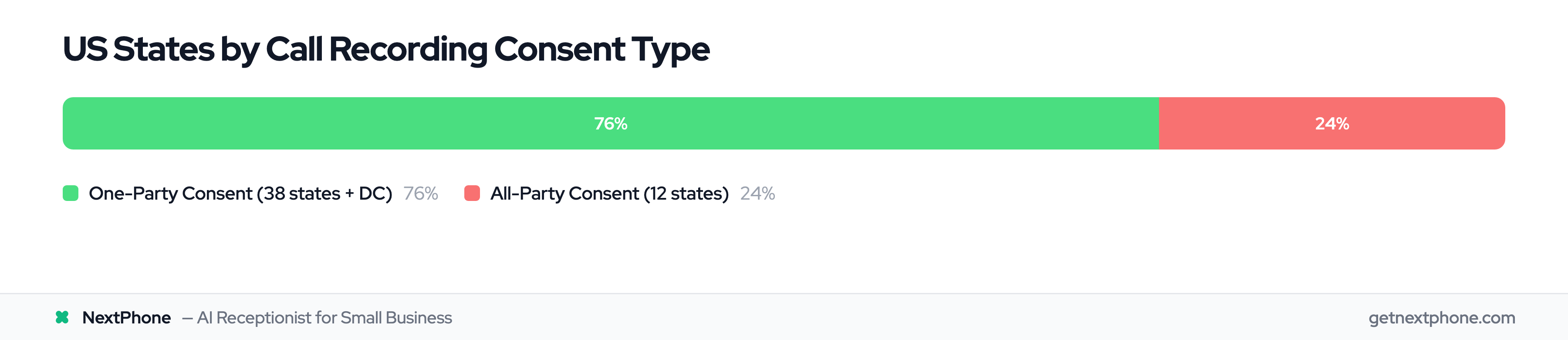
The call recording landscape splits into two categories: one-party consent states and two-party (or all-party) consent states.
One-Party Consent Explained
In one-party consent states, only one person on the call needs to know it's being recorded. That one person can be you, the person doing the recording.
If you're in Texas (a one-party state) and you're on the phone with a customer who's also in Texas, you can record the call without telling them. Your consent as a participant satisfies the law.
The key requirement: you must be a party to the conversation. You can't record other people's calls without at least one person knowing.
Two-Party (All-Party) Consent Explained
Two-party consent states require that everyone on the call knows it's being recorded and consents to the recording. Despite the name "two-party," this really means "all-party" consent. If three people are on the call, all three must consent.
In California (a two-party state), you must notify the other person and get their consent before recording. The most common method is announcing "This call may be recorded for quality assurance purposes" at the beginning of the call. If they continue the conversation, that's considered implied consent.
The terminology can be confusing. Some sources say "two-party," others say "all-party." They mean the same thing: everyone on the call must consent.
Why the Difference Matters for Businesses
The practical difference is huge.
In one-party states, you can record customer service calls, sales calls, and support calls without announcing it. Many businesses still choose to announce it for transparency, but it's not legally required.
In two-party states, you need to notify callers before recording. Every call.
If you operate in multiple states or serve customers nationwide, you need to understand which law applies to each call.
One-Party Consent States: The 38-State Majority
Most states follow the federal one-party consent standard.
Complete List of One-Party Consent States
38 states and Washington D.C. have adopted one-party consent laws:
One-party consent states (38 + DC):
- Alabama
- Alaska
- Arizona
- Arkansas
- Colorado
- District of Columbia
- Georgia
- Hawaii
- Idaho
- Indiana
- Iowa
- Kansas
- Kentucky
- Louisiana
- Maine
- Minnesota
- Mississippi
- Missouri
- Nebraska
- New Jersey
- New Mexico
- New York
- North Carolina
- North Dakota
- Ohio
- Oklahoma
- Oregon
- Rhode Island
- South Carolina
- South Dakota
- Tennessee
- Texas
- Utah
- Vermont
- Virginia
- West Virginia
- Wisconsin
- Wyoming
What One-Party Consent Means for Your Business
In these states, you can legally record calls you participate in without notifying the other person.
A plumbing company in Texas can record customer service calls for training purposes without announcing it. An electrician in Ohio can record appointment confirmations without telling customers.
But there's an important caveat: you must be a party to the conversation. Recording other people's calls without at least one person knowing requires different legal authority (like a court order).
Special Considerations in One-Party States
Even though notification isn't legally required in one-party states, many businesses choose to notify anyway. Why?
Trust and transparency. Customers appreciate knowing when they're being recorded. It builds trust rather than eroding it.
Multi-state protection. If you serve customers in multiple states, a universal notification policy ensures you're always compliant (more on this in the interstate section).
Employee relations. Recording employee calls may require notification even in one-party states, depending on your jurisdiction and employment agreements.
See the complete 50-state table below for what to do in each state.
Two-Party Consent States: The 12-State Minority
Twelve states require all parties to consent before recording a call.
Complete List of Two-Party Consent States
The 12 states that require all-party consent are:
- California
- Connecticut
- Delaware
- Florida
- Illinois
- Maryland
- Massachusetts
- Montana
- Nevada
- New Hampshire
- Pennsylvania
- Washington
These 12 states represent approximately 35% of the U.S. population, including major business hubs like California, Florida, Illinois, and Washington. If you serve customers nationally, you'll inevitably deal with two-party consent requirements.
What Two-Party Consent Means for Your Business
In these states, you must notify all parties on the call that it's being recorded and obtain their consent.
The most common method is the familiar "This call may be recorded for quality assurance purposes" message you hear when calling customer service. Playing this message at the start of the call, before any substantive conversation, satisfies the notification requirement in most cases.
If the caller continues the conversation after hearing the notification, that's generally considered implied consent. They don't need to say "yes, I consent"; staying on the line indicates consent.
State-Specific Nuances and Exceptions
Several states have unique rules that deserve special attention:
California has the strictest call recording requirements. California Penal Code § 632 requires consent from all parties before recording "confidential communications." California's recording law applies to phone calls, video calls, and in-person conversations where participants expect privacy.
Connecticut requires all-party consent for electronic communications (phone calls, video calls) but only one-party consent for in-person conversations. If you're recording a phone call with someone in Connecticut, you need their consent. If you're recording an in-person meeting, you don't.
Nevada has the opposite rule: all-party consent for phone calls, but only one-party for in-person conversations. Nevada businesses must notify callers they're being recorded, but can record in-person meetings with just one person's knowledge.
Oregon requires one-party consent for electronic communications (phone calls) but all-party consent for in-person conversations. This is the reverse of Connecticut's rule.
Massachusetts takes a different approach. Rather than requiring explicit consent from all parties, Massachusetts law bans "secret" recordings. As long as participants reasonably know they might be recorded, you're generally compliant.
Vermont has no state recording law at all. Federal one-party consent rules apply.
Michigan was previously unclear on third-party recordings, but the Sixth Circuit resolved this in AFT Michigan v. Project Veritas (2021), confirming Michigan as a one-party consent state. Recording with one participant's knowledge and consent is lawful, even if a third party operates the recording device.
These exceptions matter. A contractor in Pennsylvania must use "This call may be recorded for quality assurance" before recording customer calls. A Nevada business calling customers needs all-party consent for phone calls but not in-person conversations.
Call Recording Laws by State: Complete Reference Table
Important Legal Disclaimer: This table provides general guidance based on publicly available legal information. Laws change, interpretations vary, and this does not constitute legal advice. Consult with an attorney licensed in your jurisdiction for specific legal guidance.
| State | Consent Type | What to Do | Notes |
|---|---|---|---|
| Alabama | One-Party | You can record if you're on the call | |
| Alaska | One-Party | You can record if you're on the call | |
| Arizona | One-Party | You can record if you're on the call | |
| Arkansas | One-Party | You can record if you're on the call | |
| California | All-Party | Notify all parties before recording | Kearney v. Salomon Smith Barney (2006) extended CA rules to interstate calls. |
| Colorado | One-Party | You can record if you're on the call | |
| Connecticut | All-Party (phone) | Notify all parties on phone calls | Phone/electronic require all-party consent; in-person requires one-party only. |
| Delaware | All-Party | Notify all parties before recording | |
| Florida | All-Party | Notify all parties before recording | |
| Georgia | One-Party | You can record if you're on the call | |
| Hawaii | One-Party | You can record if you're on the call | Applies only where there is a reasonable expectation of privacy. |
| Idaho | One-Party | You can record if you're on the call | |
| Illinois | All-Party | Notify all parties before recording | All-party consent only for private, non-law-enforcement conversations. |
| Indiana | One-Party | You can record if you're on the call | |
| Iowa | One-Party | You can record if you're on the call | |
| Kansas | One-Party | You can record if you're on the call | |
| Kentucky | One-Party | You can record if you're on the call | |
| Louisiana | One-Party | You can record if you're on the call | |
| Maine | One-Party | You can record if you're on the call | |
| Maryland | All-Party | Notify all parties before recording | |
| Massachusetts | All-Party | Make sure all parties know they're being recorded | Bans "secret" recording. If participants reasonably know they may be recorded, you're good. |
| Michigan | One-Party | You can record if you're on the call | Confirmed one-party per AFT v. Project Veritas (2021). |
| Minnesota | One-Party | You can record if you're on the call | |
| Mississippi | One-Party | You can record if you're on the call | |
| Missouri | One-Party | You can record if you're on the call | |
| Montana | All-Party | Notify all parties before recording | |
| Nebraska | One-Party | You can record if you're on the call | |
| Nevada | All-Party (phone) | Notify all parties on phone calls | Phone calls require all-party; in-person requires one-party only. |
| New Hampshire | All-Party | Notify all parties before recording | |
| New Jersey | One-Party | You can record if you're on the call | |
| New Mexico | One-Party | You can record if you're on the call | |
| New York | One-Party | You can record if you're on the call | |
| North Carolina | One-Party | You can record if you're on the call | |
| North Dakota | One-Party | You can record if you're on the call | |
| Ohio | One-Party | You can record if you're on the call | |
| Oklahoma | One-Party | You can record if you're on the call | |
| Oregon | One-Party (phone) | You can record phone calls if you're on the call | Phone requires one-party; in-person requires all-party. Reverse of Connecticut. |
| Pennsylvania | All-Party | Notify all parties before recording | |
| Rhode Island | One-Party | You can record if you're on the call | No consent needed where there's no reasonable expectation of privacy. |
| South Carolina | One-Party | You can record if you're on the call | |
| South Dakota | One-Party | You can record if you're on the call | |
| Tennessee | One-Party | You can record if you're on the call | |
| Texas | One-Party | You can record if you're on the call | |
| Utah | One-Party | You can record if you're on the call | |
| Vermont | Federal Only | You can record if you're on the call | No state recording statute. Federal one-party consent applies. |
| Virginia | One-Party | You can record if you're on the call | |
| Washington | All-Party | Notify all parties before recording | |
| West Virginia | One-Party | You can record if you're on the call | |
| Wisconsin | One-Party | You can record if you're on the call | |
| Wyoming | One-Party | You can record if you're on the call | |
| Washington DC | One-Party | You can record if you're on the call |
Quick summary:
- All-Party = say "this call may be recorded" before you start. If they stay on the line, that counts as consent
- One-Party = you can record without telling anyone, as long as you're on the call
- Some states have different rules for phone vs in-person (see Notes)
For the most current information, consult an attorney in your jurisdiction or see the statute references at the bottom of this page.
Interstate Calls: Which State's Law Applies?
Here's where it gets complicated. What happens when you're in Texas calling a customer in California?
The General Rule: Stricter Law Wins
When a call crosses state lines, the general rule is that you must comply with the stricter state's law.
If one party is in a two-party consent state, treat it as a two-party consent call. Period.
This rule was established in the California Supreme Court case Kearney v. Salomon Smith Barney, Inc. (2006). The court ruled that California's two-party consent law applied to calls from Georgia (a one-party state) to California residents. Georgia's more lenient law didn't protect the company from California's stricter requirements.
The logic: California protects its residents' privacy rights regardless of where the other party is located. If you're calling a California resident, you're subject to California law.
Real-World Interstate Call Scenarios
Let's work through real examples:
Scenario 1: Texas to California You're a contractor in Texas (one-party) calling a customer in California (all-party). You must follow California's all-party consent law. Notify the customer at the start of the call.
Scenario 2: New York to Florida You're a sales rep in New York (one-party) calling a lead in Florida (all-party). You must follow Florida's all-party consent law. Use your notification script.
Scenario 3: Ohio to Texas You're in Ohio (one-party) calling a supplier in Texas (one-party). Federal one-party consent applies. You can record without notification, though notifying is still good practice.
Scenario 4: Multi-state sales team Your company has sales reps in 10 different states calling customers nationwide. You have no practical way to track every caller and customer location in real-time. Solution: Implement universal all-party consent notification for every call.
4-Step Decision Framework for Compliance
Use this framework for every interstate call:
Step 1: Identify location of all parties Where is the caller physically located? Where is the recipient? If you're using cell phones or VoIP, this can be tricky.
Step 2: Check each state's law Is each state one-party or all-party? Use the table above or the state lists in sections 3 and 4.
Step 3: Apply the strictest standard If any party is in an all-party consent state, treat the entire call as all-party consent required.
Step 4: Get documented consent Use your notification message and document that you provided it. Keep records of your compliance practices.
When in doubt, apply all-party consent. It's always safer to over-notify than under-notify.
Why Compliance Matters
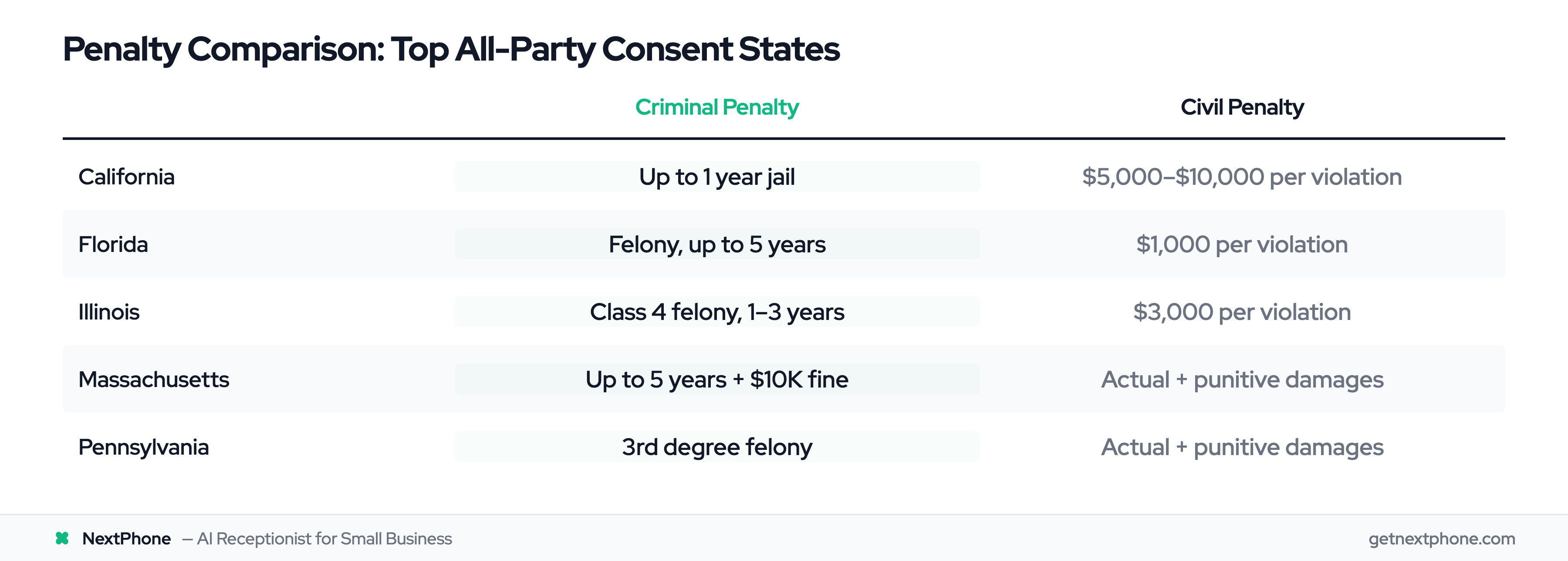
Recording without proper consent can lead to legal trouble, both at the state and federal level. The specifics vary by state, but the bottom line is the same everywhere: it's not worth the risk when compliance is so easy.
The Good News: Compliance Is Simple
Here's the thing: you don't need to memorize 50 different state laws. The fix is the same everywhere:
- Say "this call may be recorded" at the start of the call
- If they stay on the line, you're good (implied consent)
- Document that you do this consistently
That's it. If you notify on every call, you're compliant in all 50 states. No need to track which state your caller is in, no need to look anything up mid-call.
What Can Go Wrong If You Don't Comply
We're not going to get into the weeds state by state; the statutes are linked in the table above if you're curious. But broadly, here's why it's worth just notifying:
- Your recordings might not hold up in court. If you ever need to use a recording as evidence, it only helps you if it was made with proper consent.
- People can push back. If someone finds out they were recorded without being told, they can take legal action, and courts tend to side with them.
- It can hurt customer trust. Customers don't love finding out they were recorded without being told.
The easiest way to avoid all of this: just notify. It takes five seconds at the start of a call.
How to Legally Obtain Consent to Record Calls
Compliance starts with proper notification.
Three Accepted Notification Methods
The FCC recognizes three methods for obtaining consent:
1. Prior consent Get written or verbal consent before the call begins. This works for scheduled calls where you can send a consent form in advance or confirm consent at the start of a series of calls.
2. Verbal notification Announce at the beginning of the call that it's being recorded. "This call is being recorded for quality and training purposes." This is the most common method for businesses.
3. Audible beep tone An audible beep that repeats at regular intervals throughout the call to remind participants they're being recorded. This is less common for business calls and can be distracting.
Most businesses use verbal notification. It's simple, clear, and effective.
Sample Notification Scripts
Here are ready-to-use notification scripts:
Script 1 (Customer service): "Thank you for calling [Business Name]. This call may be recorded for quality and training purposes. How can I help you today?"
Script 2 (Outbound sales): "Hi, this is [Name] calling from [Business]. Before we continue, I want to let you know this call is being recorded for quality assurance. Is now a good time to talk?"
Script 3 (Explicit consent): "I want to inform you that this call will be recorded for quality assurance purposes. Do I have your consent to proceed?"
The first two rely on implied consent (continuing the call = consent). The third asks for explicit verbal consent. All three are legally valid in most jurisdictions.
Implied vs Explicit Consent
Implied consent: The caller stays on the line after hearing the notification. Most courts accept this as valid consent. The logic: if you object to recording, you would end the call.
Explicit consent: The caller verbally agrees to the recording. "Yes, I consent" or "that's fine." This provides stronger documentation but isn't required in most states.
For business purposes, implied consent is generally sufficient. Announce clearly at the start of the call, before any substantive conversation, and let the caller decide whether to continue.
Document your notification practices. Keep records showing you consistently notify callers. A call transcription service can create written records of every conversation, including the consent notification. If you're ever challenged, you can demonstrate your compliance procedures.