The $201,600 Cost of Poor HVAC Lead Qualification
It's 2 AM on a January night. Your phone rings. A family with a newborn has no heat: the temperature outside is 15°F. You're on-call, but the call goes to voicemail. They call the next contractor. You just lost a $4,200 emergency repair job.
Three hours earlier, someone called asking about scheduling an AC tune-up for next month. Your on-call tech woke up for that inquiry.
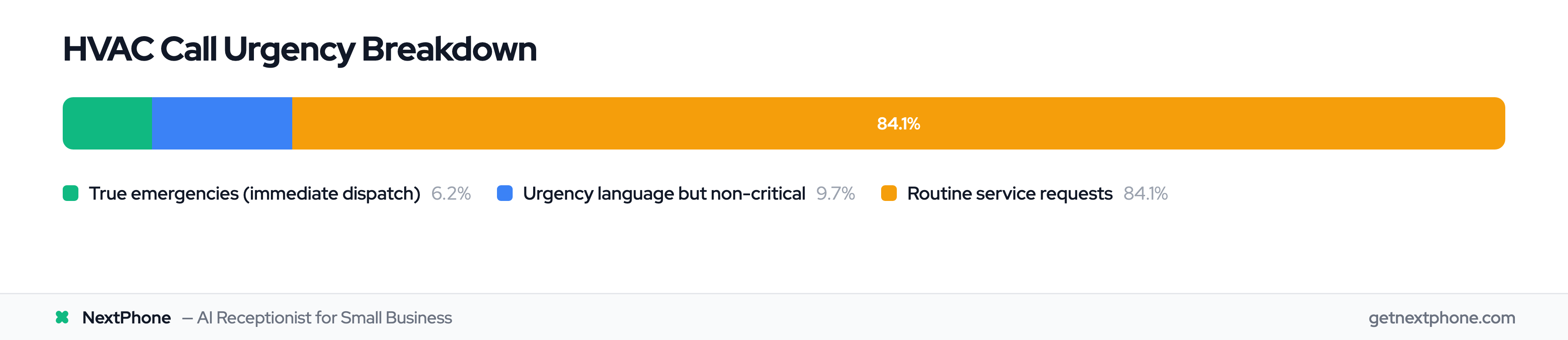
This is the HVAC lead qualification problem. Across the 1,446,980 business calls in our analysis, urgency keywords like "emergency" or "ASAP" rank among the top reasons people call. But only a fraction are actual emergencies requiring immediate dispatch. Without a systematic lead qualification workflow, you're either missing high-value emergency calls or burning out your technicians on routine inquiries.
The math is brutal. Missing just one emergency call per week costs $16,800 per month in lost revenue: that's $201,600 per year. And that's only counting the direct job loss, not the referrals you'll never get from that dissatisfied customer.
Why HVAC Lead Qualification Matters
The Cost of Missed Emergency Calls
HVAC contractors face a unique challenge that most service businesses don't. 60% of home service companies say labor shortages affect job completion, and 84% of consumers contact an HVAC company after searching online.
Your emergencies are literally life-safety situations. No heat in winter can lead to frozen pipes, hypothermia, and property damage. Total AC failure in extreme summer heat puts vulnerable populations (infants, elderly, people with medical conditions) at genuine risk. Service pros lose 27% of leads to slow response.
According to research on HVAC maintenance statistics, emergency HVAC repairs cost 50-100% more than standard service calls. For every dollar spent on preventive maintenance, you save $4 in avoided breakdown costs. But here's the problem: you can't capitalize on that emergency premium if you're missing the calls in the first place.
NextPhone call data shows that 74.1% of calls to home services businesses go completely unanswered. That's three out of every four potential customers reaching voicemail and calling the next contractor. For HVAC companies handling 42 calls per month, that's 31 missed opportunities.
Four out of five first-time callers will hang up if they can't reach a human being, with the vast majority never calling back. Delays account for 55% of negative HVAC reviews. In the HVAC business, speed matters, especially for emergencies.
The Cost of Unqualified Lead Chasing
The flip side is equally expensive. Without qualification, your technicians waste time on unqualified leads during peak season.
A 2025 FIELDBOSS survey found that 49% of recent HVAC service calls were for routine maintenance versus only 32% for repairing breakdowns. If you're dispatching senior technicians to price-shoppers while real emergencies go to voicemail, you're losing money twice.
Companies that respond within five minutes/) are 8 times more likely to land the job. But responding quickly to the wrong leads doesn't help. You need to respond to qualified emergencies within five minutes, while routing routine inquiries to scheduled appointments.
The Seasonal Qualification Challenge
HVAC demand isn't consistent. According to Samsara's analysis of 65 million HVAC service trips, October, not July, is actually the busiest month of the year. During peak season when temperatures reach the 90s, customers can expect to wait up to ten days for appointments.
When you're slammed with 50+ calls per day during a heat wave, every minute counts. One contractor increased their Q1 call volume by over 500 appointments by implementing better scheduling, adding $250,000 in revenue and $55,000 in gross profit.
The qualification challenge is prioritization. A no-heat call in January is life-threatening. An AC tune-up request in April can wait. Your qualification system needs to recognize the difference instantly.
Emergency vs Non-Emergency HVAC Triage
Life-Safety Emergencies (Immediate Dispatch)
Not all HVAC calls are created equal. Some require immediate dispatch, while others can wait. The key is establishing clear criteria for what constitutes a life-safety emergency.
Immediate dispatch situations:
- No heat in winter when outdoor temperature is below 32°F
- Gas leak or strong gas odor from furnace or boiler
- Carbon monoxide alarm triggered
- Electrical sparks, smoke, or fire risk from HVAC equipment
- Total AC failure with vulnerable occupants (infants, elderly, medical conditions) when outdoor temperature exceeds 95°F
- Boiler leaking with water damage and no heat
- Commercial HVAC failure affecting critical operations (server rooms, medical facilities, food service)
These aren't comfort issues. They're safety emergencies. According to emergency HVAC call handling protocols, cases involving gas leaks or potential safety hazards demand immediate attention, taking priority over all other service requests.
True emergencies like these are a recurring reason people call. Missing even one of these calls costs you an average of $4,200 in emergency revenue, and potentially exposes a family to danger.
Comfort Emergencies (Same-Day/Next-Day)
The next tier down is comfort emergencies. These are urgent, but not immediately life-threatening.
Same-day or next-available dispatch:
- AC total failure in summer heat (no vulnerable occupants)
- Heating system providing reduced heat (not total failure) in winter
- HVAC system making alarming or unusual noises
- Water leaking from AC unit or condensate drain
- Heat pump stuck in auxiliary heat mode (high energy bills)
- Commercial HVAC affecting employee comfort but not safety
These calls make up the bulk of urgent-sounding volume. They're urgent enough that customers won't wait a week, but they can wait a few hours or until the next available appointment slot.
Your response time here matters for customer satisfaction and conversion, but you're not risking life safety by scheduling for later in the day.
Routine Service Requests (Scheduled)
Everything else is routine and should be scheduled during normal business hours.
Scheduled appointments:
- Annual tune-ups and preventive maintenance
- Filter changes and cleaning
- Efficiency improvements and upgrades
- Non-urgent repairs (system works but not optimally)
- Installation quotes and consultations
- Duct cleaning and air quality services
The FIELDBOSS data shows that 49% of HVAC calls fall into this category. These are important revenue opportunities, but they shouldn't displace emergencies or burn out your on-call technicians at 2 AM.
The HVAC Emergency Decision Tree
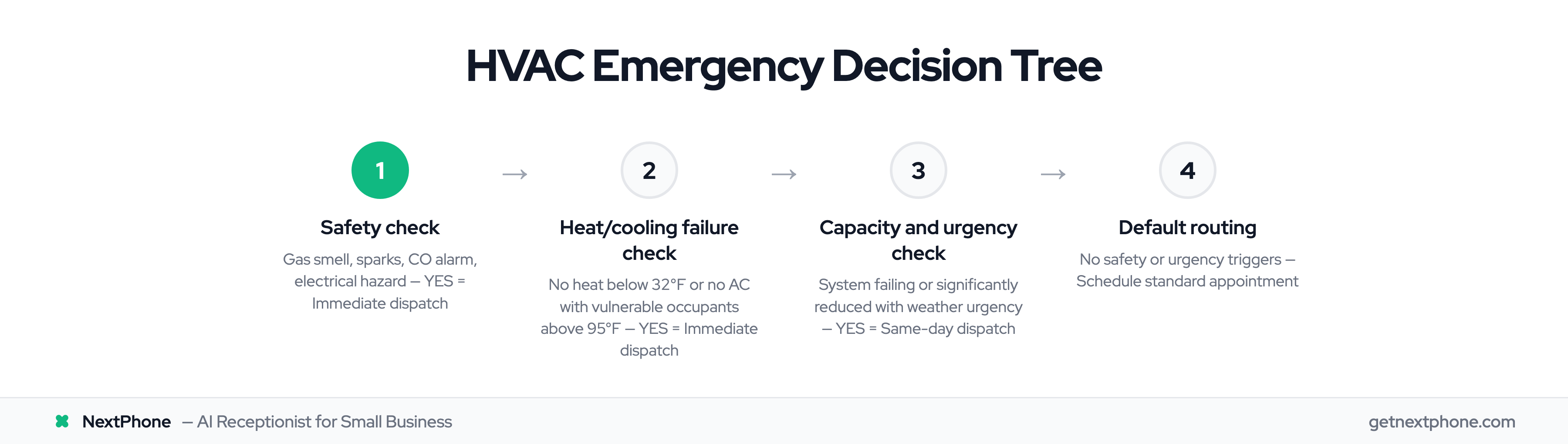
Here's the qualification flow:
Step 1: Is there a safety issue? (Gas smell, sparks, carbon monoxide alarm, electrical hazard) → YES: Immediate dispatch (Tier 1) → NO: Continue to Step 2
Step 2: Is the system providing NO heating in winter (below 32°F outside) or NO cooling with vulnerable occupants in extreme heat (95°F+)? → YES: Immediate dispatch (Tier 1) → NO: Continue to Step 3
Step 3: Is the system failing or significantly reduced in capacity with weather urgency? → YES: Same-day/next-available dispatch (Tier 2) → NO: Scheduled appointment (Tier 3)
This simple decision tree can be followed by a receptionist, answering service, or AI system to route calls appropriately.
The HVAC Lead Qualification Script
Essential Qualifying Questions
Every HVAC call should go through a standardized qualification process. Here are the 10 essential questions:
- What type of property is this? (Residential home, apartment, commercial building)
- What's the issue you're experiencing? (No heat, no cooling, strange noise, leak, etc.)
- When did this start? (Just now, today, this week, ongoing)
- Is anyone at risk? (Infants, elderly, people with medical conditions in the home)
- What type of HVAC system do you have? (Furnace, AC, heat pump, boiler, ductless)
- How old is your system? (Age indicates likelihood of replacement vs repair)
- Is it under warranty? (Affects routing and pricing)
- What's your ZIP code? (Service area verification)
- When do you need service? (Immediately, today, this week, flexible)
- What's your budget range, and are you the decision-maker? (Qualification for serious buyers)
These questions accomplish three things: identify urgency level, determine routing requirements, and qualify the lead's readiness to buy.
Emergency-Specific Follow-Ups
If the initial questions suggest an emergency, drill deeper:
- What's the current indoor temperature? (Actual measurement, not guess)
- What's the outdoor temperature right now? (Weather context)
- Are there vulnerable people in the home? (Infants under 1 year, adults over 65, medical conditions)
- Do you smell gas or notice any sparks? (Safety hazard confirmation)
- Have you checked your thermostat and circuit breaker? (Basic troubleshooting)
These follow-ups help distinguish between true emergencies and issues that might be resolved with basic troubleshooting.
Commercial vs Residential Identifiers
Commercial HVAC calls require different information:
- How large is the building? (Square footage determines system complexity)
- How many HVAC units do you have? (Scale of the problem)
- What type of business operates there? (Affects urgency: restaurant vs office)
- Are you the facilities manager or building owner? (Decision-making authority)
According to ServiceTitan's research on commercial HVAC, commercial systems are much more complex and require technicians with more experience and specialized education. You can't send a residential-only tech to a commercial building with rooftop units.
Warranty and System Information
Don't skip these questions; they affect routing and revenue:
- What brand and model is your system? (Warranty lookup, parts availability)
- Do you have the installation date or know the system age? (Systems over 10 years old are replacement candidates)
- Is your system under manufacturer warranty or do you have a maintenance contract with us? (Routing and pricing implications)
Warranty calls often need to route to manufacturer-certified techs. Maintenance contract customers get priority scheduling. These details matter for both customer satisfaction and revenue optimization.
Seasonal Routing Logic
Summer Priority: Air Conditioning Emergencies
From May through September, your routing logic needs to prioritize cooling failures.
Summer emergency criteria:
- Total AC failure with outdoor temperature above 90°F = Emergency (same-day dispatch)
- Total AC failure with outdoor temperature above 95°F and vulnerable occupants = Critical emergency (immediate dispatch)
- AC providing reduced cooling in high heat = Urgent (same-day or next-day)
- AC making unusual noises or leaking = Moderate (within 2-3 days)
- AC tune-up or maintenance = Routine (scheduled)
Heating inquiries during summer months are almost always routine and can be scheduled for fall or handled at lower priority.
Winter Priority: Heating System Failures
From November through March, heating failures become your top priority.
Winter emergency criteria:
- No heat with outdoor temperature below 32°F = Critical emergency (immediate dispatch)
- No heat with outdoor temperature 32-50°F = Emergency (same-day dispatch)
- Reduced heat in freezing weather = Urgent (same-day or next-day)
- Furnace making banging noises or smelling like gas = Safety emergency (immediate dispatch)
- Boiler leaking = Emergency (immediate dispatch due to water damage + no heat)
- Heating system tune-up = Routine (scheduled)
AC inquiries during winter are typically installations or quotes, which can be scheduled for consultation appointments.
Shoulder Season: Maintenance and Efficiency
April and October are your maintenance opportunity windows.
During these months, adjust your qualification to promote preventive maintenance:
- "We're booking fall tune-ups now before the winter rush. Can I schedule you for next week?"
- "Spring is the perfect time for AC maintenance before summer heat. We have availability this month."
The Samsara data shows that October is actually the busiest month of the year, likely because contractors are doing both fall heating maintenance and late-season AC repairs.
Weather-Based Escalation Triggers
Set up weather-based automatic priority escalation:
- Heat advisory (95°F+): All AC failure calls automatically escalate to emergency status
- Excessive heat warning (100°F+): AC calls get priority over all non-safety issues
- Freeze warning (32°F or below): All heating failure calls automatically escalate to emergency
- Winter storm warning: Heating calls get 24-hour priority response
During extreme heat watches, HVAC fleets recorded 14 more trips per vehicle compared to normal periods. Your qualification system needs to recognize these weather patterns and adjust routing accordingly.
System Type Identification & Urgency Levels
Furnace Issues: Winter Life-Safety Priority
Forced-air furnaces are the most common residential heating system. Failures during winter can be life-threatening.
Furnace emergency indicators:
- No heat output with outdoor temp below freezing
- Strong gas odor (potential leak)
- Yellow or flickering pilot light (carbon monoxide risk)
- Repeated shutdowns or failure to ignite
- Banging, rumbling, or screeching noises
Gas furnace issues always get elevated priority due to carbon monoxide and explosion risks. Even a "reduced heat" call should be same-day in winter.
Qualification question: "Is your furnace gas or electric? Do you smell gas or notice a yellow flame?"
Air Conditioner Problems: Summer Comfort Priority
Central AC failures are comfort emergencies in summer, becoming life-safety emergencies when vulnerable people are involved.
AC emergency indicators:
- No cooling with outdoor temp above 90°F
- Frozen evaporator coil (system not working)
- Refrigerant leak (environmental concern + system failure)
- Electrical issues (sparks, burning smell, tripped breakers)
- Compressor failure (expensive repair, system down)
Qualification question: "Is your AC blowing warm air, or not blowing at all? Is anyone in the home particularly sensitive to heat?"
Heat Pump Failures: Year-Round Concerns
Heat pumps provide both heating and cooling, so the season determines urgency.
Winter heat pump priority:
- Heat pump not heating = Same urgency as furnace failure
- Auxiliary heat constantly running = Moderate urgency (high energy bills, system strain)
- Heat pump not switching modes = Urgent
Summer heat pump priority:
- Heat pump not cooling = Same urgency as AC failure
- Heat pump stuck in heating mode in summer = Urgent (uncomfortable + wasted energy)
Qualification question: "Is your heat pump providing no heat, no cooling, or is it not switching between modes?"
Boiler Emergencies: Immediate Response Required
Boilers are common in commercial buildings and older residential properties. They're also the most complex HVAC systems.
Boiler emergency indicators:
- Boiler leaking water = Critical (water damage + no heat)
- Boiler pressure problems = Moderate to high urgency
- Boiler not producing heat in winter = Emergency
- Strange noises from boiler = Moderate urgency
- Pilot light issues = Moderate urgency
Boilers often require specialized commercial HVAC technicians. According to the ServiceTitan research, commercial systems require more experienced technicians with specific certifications.
Qualification question: "Is your boiler leaking? What's the pressure gauge reading? Is this for a home or commercial building?"
Commercial vs Residential HVAC Routing
Identifying Commercial vs Residential Calls
The first qualification question should always be: "Is this for a residential home or a commercial building?"
Commercial HVAC calls require different handling:
Additional commercial questions:
- Building size (square footage)
- Number of HVAC units
- Type of business (affects urgency: restaurant vs warehouse)
- Who's calling (building owner, facilities manager, tenant)
- Are operations affected? (Lost revenue increases urgency)
A restaurant with no AC in summer is losing money every hour they can't operate. That's a higher urgency than an office building where employees are just uncomfortable.
Commercial HVAC Qualification Criteria
Commercial systems are more complex. According to the ServiceTitan data, commercial technicians have more experience and education than residential technicians due to the complexity involved.
Commercial urgency factors:
- Business impact (revenue loss if operations shut down)
- Number of people affected (100 employees vs 4 family members)
- Regulatory compliance (food service, healthcare, server rooms)
- System complexity (rooftop units, chillers, multiple zones)
Commercial routing requirements:
- Certified commercial HVAC technician
- Equipment to access rooftop units
- Experience with complex zoning systems
- Knowledge of commercial building codes
Don't send a residential tech to a commercial job. They may not have the certifications, equipment, or experience to handle the system safely and effectively.
Residential HVAC Qualification Criteria
Residential calls focus on life-safety and homeowner comfort.
Residential urgency factors:
- Vulnerable occupants (infants, elderly, medical conditions)
- Weather severity (temperature extremes)
- System age (replacement vs repair decision)
- Homeowner budget and decision-making authority
Residential routing requirements:
- Standard residential HVAC certification
- Familiarity with common residential systems
- Good communication skills (explaining options to homeowners)
- Sales ability (presenting repair vs replacement options)
Residential calls can usually be handled by any qualified HVAC tech on your team, making scheduling more flexible than commercial jobs.
Technician Skill Matching Requirements
Create a skill matrix for your technicians:
Master/Senior Techs:
- Commercial HVAC systems
- Complex diagnostics
- Boiler specialists
- System replacements
- Emergency repairs
Mid-Level Techs:
- Standard residential HVAC
- Common repairs
- AC and furnace service
- Warranty work
Junior Techs:
- Maintenance and tune-ups
- Filter changes
- Basic diagnostics
- Scheduled appointments
Route calls based on complexity and urgency. Don't waste a senior tech's time on a routine filter change when a junior tech can handle it. And don't send a junior tech to a commercial boiler emergency.